



Raptor
Behavioral targeting: turn customer behaviour into relevant action
8 min - 24 November 2026

Behavioral targeting uses customer actions as signals to decide who should receive a particular message, experience or marketing action. Instead of relying only on broad profile characteristics, it adds context from what people actually do: the products they explore, the categories they return to, the purchases they make and the moments when their engagement changes.
For ecommerce teams, this makes behaviour a useful source of intent. Raptor, the Agentic Customer Data Platform, collects behavioural and transactional data that can feed customer profiles and audiences, helping teams move from observing behaviour to deciding what should happen next.
The principle is straightforward: a behavioural signal becomes valuable when it improves a decision.
Key point Behavioral targeting connects meaningful customer behaviour with a relevant next action. The goal is to respond to useful signals. |
What is behavioral targeting?
Behavioral targeting is the practice of using observed customer behaviour to determine whether someone should receive a particular marketing message, experience or action.
Behaviour can come from a single interaction or from a pattern over time. Someone who views the same product several times may be showing stronger interest than a visitor who viewed it once. A customer who regularly bought from one category and suddenly stops engaging is sending a different signal.
The targeting decision depends on what that behaviour means in context.
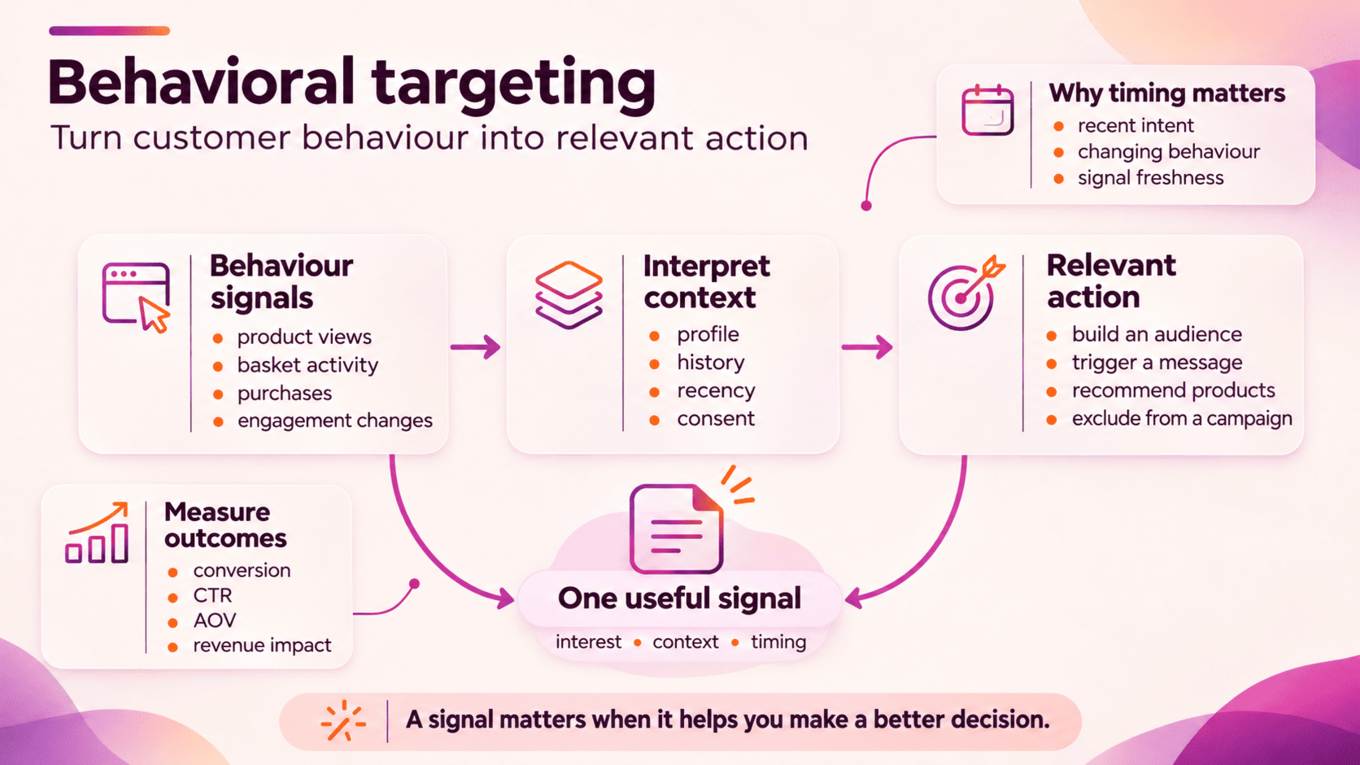
Behaviour → context → targeting decision → action
The action might involve adding someone to an audience, triggering a communication, changing the products they see or excluding them from a campaign that is no longer relevant. Behavioral targeting therefore goes beyond observing customer activity. The important step is deciding which behaviours are meaningful enough to influence what happens next.
Which customer behaviours can signal intent?
Ecommerce customers generate many behavioural signals throughout their journey. Some are explicit, such as adding a product to a basket. Others only become useful when they form a pattern.
Common signals include:
- viewing a product or category repeatedly;
- adding products to or removing them from a basket;
- saving products as favourites;
- completing a purchase;
- returning after a period of inactivity;
- increasing or decreasing visit frequency;
- showing sustained interest in a particular product category.
Each signal needs interpretation. A product view can indicate interest, research or simple curiosity. Five visits to the same category over several days carry more weight. An abandoned basket may suggest unresolved purchase intent, while a recent purchase can make some promotional messages immediately irrelevant.
This is why behavioral targeting works best when teams start with the decision they want to improve. The useful question is: which behaviour should change what we do?
Behavioral targeting vs behavioural segmentation
Behavioural segmentation groups customers according to shared behaviours or behavioural patterns. A retailer might create groups of frequent buyers, customers interested in a particular category or customers whose activity has recently declined.
Behavioral targeting uses behaviour, or an audience created from it, to determine who may be relevant for a particular action or experience.
Segmentation can therefore support targeting. For example, an audience of customers who repeatedly browse running products is a behavioural segment. Choosing to show that audience a relevant running campaign is a targeting decision.
From behavioural data to an audience
Behaviour becomes easier to use at scale when individual interactions can feed a broader customer profile.
A typical process involves several steps:
- capture relevant customer behaviour;
- connect it with the available customer context;
- define the conditions that matter for the use case;
- identify customers who meet those conditions;
- activate the resulting audience or signal through an appropriate channel.
A Customer Data Platform can provide the infrastructure that brings these signals together with other customer information.
Raptor’s Audience Builder can then create audiences from behavioural and purchase data alongside customer attributes. Audience membership can change as new information arrives, allowing targeting criteria to continue reflecting changes in customer behaviour.
This matters because behaviour has a time dimension. Someone who showed interest in a product six months ago does not represent the same opportunity today.
Practical principle The best audience is the one whose conditions identify customers who are relevant to the intended action. The number of conditions is not the measure of quality. |
Behavioral targeting examples in ecommerce
The easiest way to understand behavioral targeting is to look at the relationship between a signal and the decision it can support. A customer repeatedly explores the same category or returns to a specific product.
That behaviour may indicate developing intent. A retailer can use it to qualify the customer for a relevant audience or prioritise products related to that interest. The useful signal is the repeated pattern.
Adding a product to a basket is a stronger behavioural signal because the customer has moved closer to purchase. If the basket is later abandoned, that event can support a follow-up action while the intent is still relevant.
Purchase behaviour is also useful for exclusion.
A customer who has just bought a product may no longer need an acquisition message for the same item. The purchase can instead provide context for complementary recommendations, service communications or a later replenishment use case.
Good targeting therefore includes knowing when a customer should leave an audience.
Behaviour can also show what has stopped happening.
A customer who used to purchase frequently but whose visits or transactions have declined may require a different approach from someone who remains consistently active.
This becomes more useful when behavioural information is combined with customer value or purchase history. A drop in activity from a historically valuable customer may deserve different attention from the same behaviour in a very low-engagement profile.
Customer value and current behaviour answer different questions.
Value provides context about the relationship. Behaviour shows what is happening now. Combining both can help teams identify customers whose current behaviour deserves attention, such as valuable customers showing signs of disengagement or active customers whose engagement is increasing.
Raptor’s current AI-suggested audience templates use CDP data and Customer Lifetime Value modelling to provide starting points for scenarios such as highly engaged customers, valuable customers showing signs of disengagement and previously active customers who have become inactive.
Email Triggers are another example of this principle in practice. Behaviour such as basket activity, product interest or favourites can create a trigger that is then passed to the organisation’s email platform.
Why timing matters in behavioral targeting
Behaviour changes meaning over time. Someone who viewed a product ten minutes ago is in a different context from someone who viewed it six months ago. The same applies to basket activity, category interest, visit frequency or declining engagement.
Recency therefore needs to be considered alongside the behaviour itself. The freshness required depends on the use case. An abandoned basket may call for a relatively quick response, while customer-value or retention audiences develop over much longer periods.
Teams should decide how long a signal remains useful before building targeting logic around it. This also prevents historical behaviour from outweighing current intent. A customer who used to buy running products may now be looking for something completely different. Good targeting gives recent and relevant behaviour the appropriate weight.
Behavioral targeting and personalisation
Behavioral targeting and personalisation often work together, but they answer different questions. Targeting helps determine who may be relevant for an action or experience based on meaningful signals.
Personalisation determines which experience is most relevant for a particular customer or context. For example, repeated interest in garden furniture could qualify someone for an audience used in a seasonal campaign. Once the person qualifies, personalisation can influence the products or recommendations they see within that experience.
Keeping this distinction clear prevents targeting from becoming a catch-all term for every form of individualisation.
How Raptor supports behaviour-based targetingRaptor does not need a separate product called Behavioral Targeting for behaviour-based targeting to become operational. It is enabled through existing capabilities. Its CDP brings together behavioural and transactional customer information. Audience Builder can then use behaviour, purchases and customer attributes to define audiences. Those audiences can support activation across connected marketing and ecommerce experiences. Raptor also uses customer behaviour in more specific decision contexts. Email Triggers can react to events such as product visits, favourites, basket activity and purchases, while recommendation capabilities use behavioural context to influence relevant product suggestions. The common principle remains the same: observed behaviour provides context for deciding what should happen next. Teams that want to understand these signals more deeply can also explore how customer insights turn behavioural, audience and customer-value data into information that supports decisions. |
What to look for in a behavioral targeting approach
A useful behavioral targeting approach should help teams identify meaningful signals and connect them with measurable actions.
A practical evaluation should cover several areas.
- Which behaviours are available, and do they reveal something genuinely useful about customer intent or engagement?
- Can behavioural signals be combined with relevant profile, purchase or customer-value information when the use case requires it?
- How quickly does new behaviour become available, and how long should each signal remain relevant?
- Can teams understand why a customer qualifies for a particular audience or action?
- Can behaviour-based audiences or signals be used in the channels where the business needs them?
- Can customers leave an audience when their behaviour changes, they convert or the targeting condition is no longer relevant?
- Can teams determine whether the targeting decision improved the intended outcome?
- Is behavioural data collected, processed and used according to appropriate consent, privacy and access rules?
Evaluation question If your customers’ behaviour changes tomorrow, can your targeting change with it, and can your team understand why? |
Better targeting starts with a meaningful signal
Behavioral targeting gives ecommerce teams a way to use customer actions as context for marketing decisions.
The process starts by identifying the behaviour that matters. That behaviour can then feed a customer profile or audience, providing the basis for deciding who should receive a particular message, experience or action.
The strongest approach keeps the relationship between signal and action clear. A product view, purchase or change in engagement only becomes useful when it tells the business something relevant and leads to a better decision.
That is the value of behavioral targeting for ecommerce teams: turning customer behaviour into context that improves what happens next.