



Raptor
Product recommendations: 8 ecommerce strategies
5 min - 26 November 2026

What are product recommendations? Product recommendations are selected products shown to a shopper because they are likely to be relevant in that specific context. They can respond to current behaviour, past purchases, product relationships, popularity, business rules or a combination of signals.
In ecommerce, recommendations reduce the work required to navigate a large catalogue. They can help a shopper continue a journey, compare alternatives, discover complementary products or return to products that match a known preference.
The quality of a recommendation programme depends on more than the algorithm. Placement, timing, product availability, customer context and the commercial objective all shape whether a recommendation is useful.
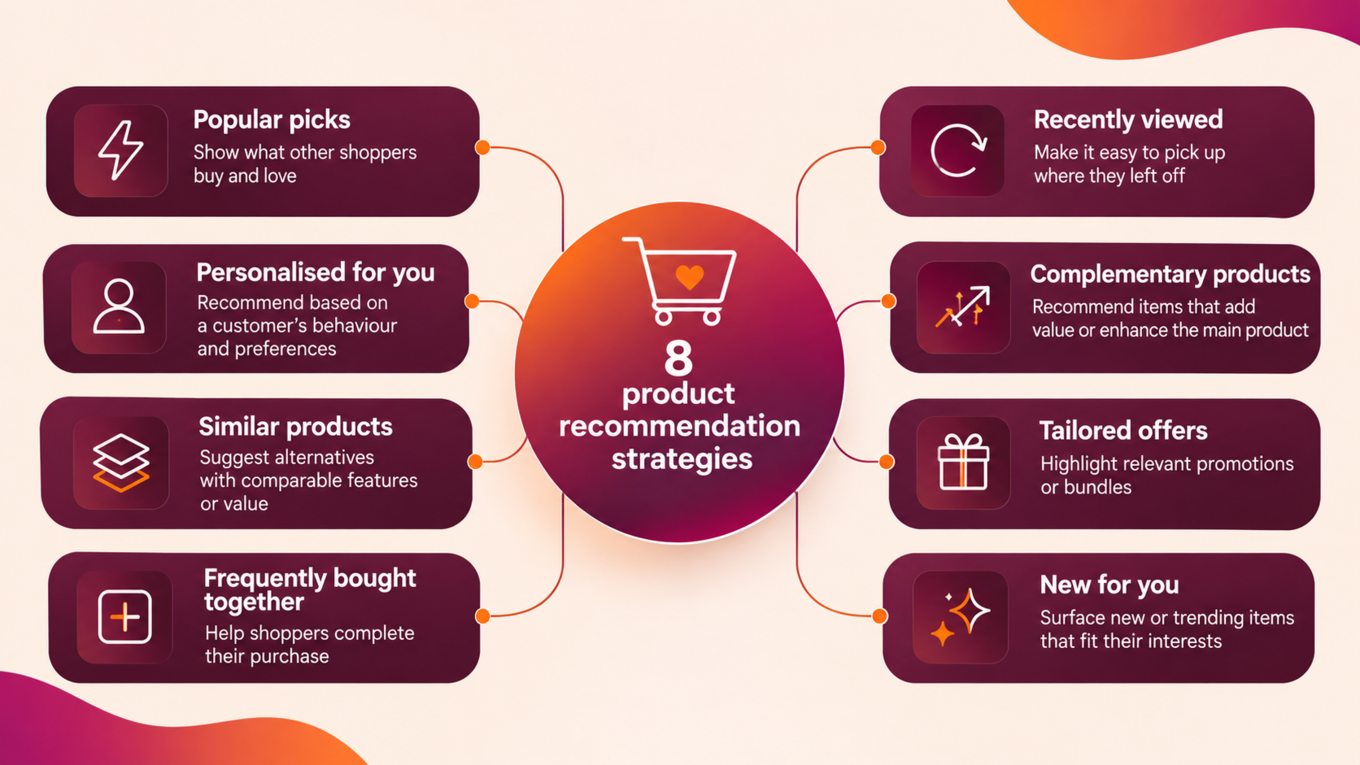
8 practical product recommendation strategies
- Popular products: show products that perform well overall or within a category when little individual data is available.
- Recently viewed: help returning visitors reconnect with products they have already considered.
- Similar products: offer alternatives based on category, attributes, brand, price or behavioural similarity.
- Frequently bought together: introduce complementary products around a current product or basket.
- Personalised recommendations: use browsing and purchase behaviour to adapt product selection to the individual.
- Next-best products: adjust recommendations as the shopper moves from exploration towards purchase or cross-sell.
- Replenishment and repeat purchase: surface products that customers are likely to need again based on previous purchases.
- Business-priority recommendations: combine relevance with rules that favour selected products, categories or campaigns where appropriate.
Where should product recommendations appear?
Recommendation placement should follow the task the shopper is trying to complete.
- Homepage: reconnect returning visitors with relevant categories and products.
- Category and listing pages: widen discovery and help shoppers reach useful items faster.
- Product detail pages: present alternatives, similar products and complementary items.
- Basket: support cross-sell with products that make sense with the current order.
- Email: extend recommendation logic beyond the website using customer and product data.
- Post-purchase journeys: support replenishment, complementary purchases and future discovery.
How AI improves product recommendations
AI can process behavioural and product signals at a scale that manual merchandising cannot match. The useful distinction is practical: AI can continually update which products are most relevant as customer intent changes, while marketers retain control over the strategy and business rules.
Raptor Website Recommendations uses behavioural data to personalise recommendations across homepage, category, product and basket pages. Raptor currently offers more than 20 pre-built recommendation strategies, which teams can tune to their business goals.
See Raptor Website Recommendations
What data improves recommendation quality?
- Current browsing behaviour and product views.
- Purchase history and basket activity.
- Product catalogue attributes such as category, brand, price and availability.
- Customer identity and profile data when available.
- Context such as placement, device, channel and journey stage.
- Business rules that control which products can or should be promoted.
A strong recommendation programme also needs reliable identifiers and catalogue data. Poor product data can limit the quality of the result even when the recommendation logic is sophisticated.
How to measure product recommendations
Measure recommendation performance by use case and placement rather than treating all recommendation modules as one programme.
- Interaction or click-through rate on recommendation modules.
- Add-to-basket rate after recommendation interaction.
- Conversion rate for sessions that interact with recommendations.
- Average order value and products per order.
- Revenue per visit or revenue attributed to recommendation placements.
- Coverage and diversity, to understand whether recommendations expose enough of the catalogue.
Case-study results should stay attributed to the individual customer. XL-BYG, which manages more than 200,000 products, reports that customers interacting with Raptor recommendations show a 273% higher conversion rate, a 37% higher average order value and 66% more unique products per order than the comparison group. Plantorama reports a 40% conversion increase after recommendations began to reflect local store availability. These results describe two implementations, not a universal uplift.
How to choose product recommendation software
- Check which behavioural and transactional signals the platform can use.
- Confirm that recommendation strategies fit the journey stages and catalogue structure you actually
- have.
- Look for marketer control over placement, strategy and business rules.
- Check integration with the ecommerce, email and customer-data stack.
- Make sure performance can be measured by module and use case.
- Confirm how anonymous and identified customer behaviour are handled.
- Test how the system adapts when customer intent changes.
Where Raptor fitsRaptor combines customer data with website and email recommendations, merchandising, behavioural triggers and search. For recommendation use cases, Website Recommendations adapts product selection using customer behaviour and pre-built strategies, while marketers can tune the strategy to commercial goals. This makes recommendations one activation layer within a wider customer-data and personalisation setup, rather than an isolated widget. |
Product recommendations: the practical takeaway
The strongest recommendation programmes start with a clear customer task and a measurable commercial objective. Choose the right placement, use the signals available, apply a strategy that fits that moment and measure the result. AI increases the ability to adapt at scale, while the quality of the customer and product data still determines what the system has to work with.