



Personalization
What is a personalization engine? How real-time personalization works
6 min - 18 November 2026
A personalization engine uses customer data and behavioural signals to decide which content, products or experiences are most relevant to an individual customer or context. It turns customer information into decisions that can be used across websites, ecommerce experiences, email and other channels.
For ecommerce and marketing teams, the objective is to make better decisions about what each customer should see next, beyond personalising more.
What is a personalization engine?
A personalization engine is a system that analyses available customer and contextual data and uses it to determine the most relevant experience for a user. Depending on the use case, that decision might be:
- which products to recommend;
- how products should be ranked;
- which audience a customer belongs to;
- which message or offer should be shown;
- whether a customer should receive a trigger;
- which experience should appear on a particular page or channel.
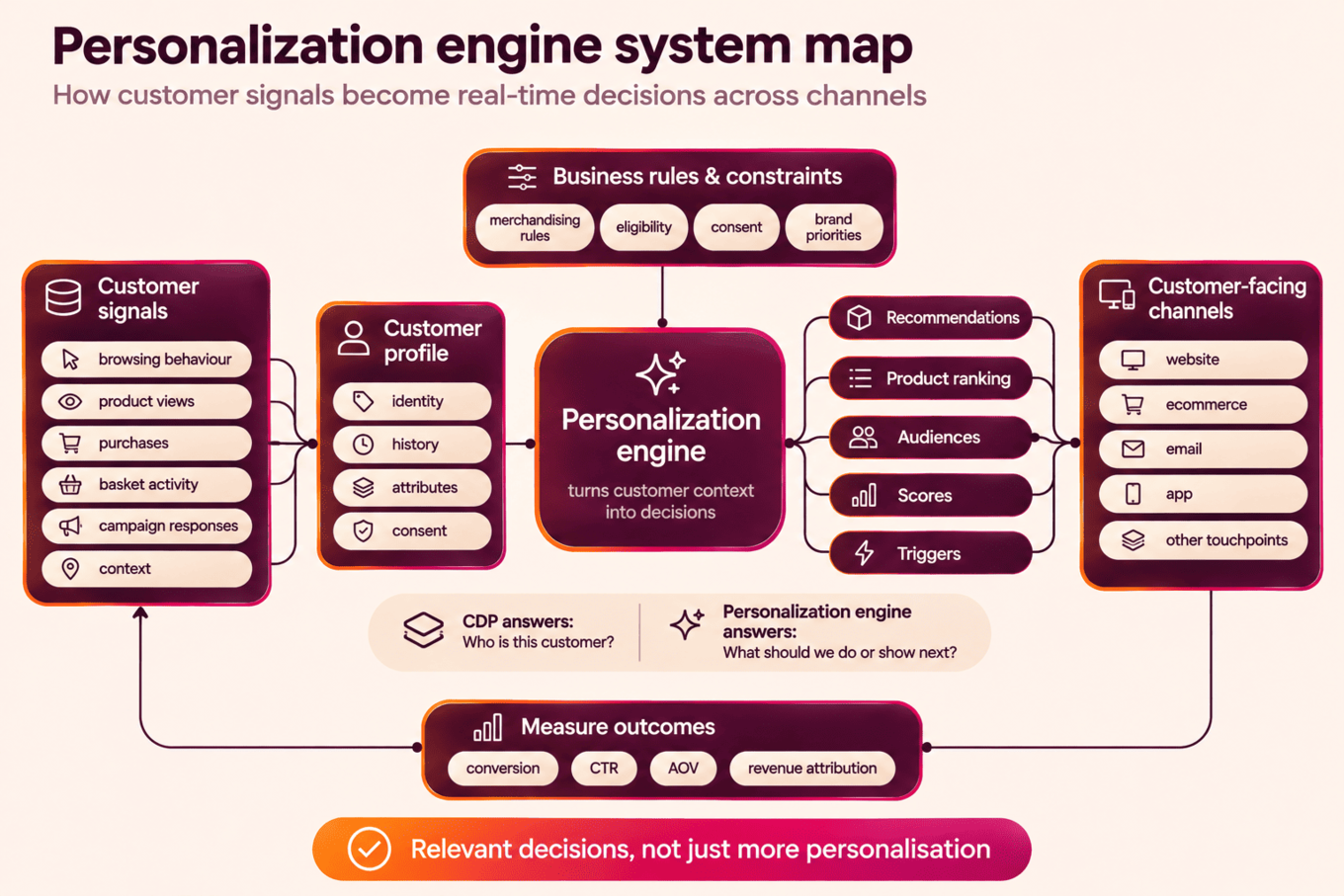
Personalization engines therefore sit between customer data and customer-facing experiences. The data provides context, and the engine decides what to do with it.
How does a personalization engine work?
Most personalisation systems involve four broad steps.
1. Collect customer signals
The engine first needs information about customer behaviour and context. Signals can include:
- browsing behaviour;
- product views;
- purchases;
- basket activity;
- interaction history;
- customer profile data;
- previous responses to campaigns;
- contextual information such as the current page or channel.
Not every customer will have the same amount of data available. An anonymous visitor may only provide session behaviour, while a known customer may have a much richer history.
2. Build or access a customer profile
Customer signals become more useful when they can be connected to a coherent profile. Instead of treating every interaction independently, a personalisation system can use the profile to understand the customer across multiple interactions.
The quality of that profile matters. Duplicate identities, disconnected data or outdated information can all reduce the quality of subsequent decisions.
3. Decide what is most relevant
The engine evaluates available data against possible actions or experiences. Depending on the use case, it may select a product recommendation, rank products, assign an audience, generate a score or determine whether a trigger should fire. This is where customer data becomes an actionable choice.
4. Deliver the decision
The decision then needs to be used by another system or customer touchpoint. That might be an ecommerce website displaying product recommendations, an email platform inserting personalised products or another application requesting the next best decision.
Personalisation therefore depends on good data and models, and on the ability to make decisions available where they are needed.
Personalization engine vs recommendation engine
A product recommendation engine and a personalization engine are related and distinct. A recommendation engine answers a relatively specific question: Which products should we recommend?
A personalization engine can address a broader range of decisions: What should this customer see or experience next?
Product recommendations can therefore be one capability within a wider personalization engine. For example, the same customer context might be used to:
- recommend products on a product page;
- rank items differently in a listing;
- place the customer in a particular audience;
- calculate a score;
- trigger a relevant communication.
This distinction matters when evaluating technology. A retailer may only need product recommendations, while another organisation may need a broader personalisation capability that supports several use cases.
Personalization engine vs Customer Data Platform
A Customer Data Platform and a personalization engine perform different roles. A CDP focuses on customer data: it brings information together to build usable customer profiles and audiences. A personalization engine uses customer information to make decisions. In simple terms:
- The CDP helps answer: who is this customer?
- The personalization engine helps answer: what should we do or show next?
In practice, the two capabilities can be closely connected. A better customer profile gives the personalization engine more context, and better personalisation decisions make customer data more useful in actual experiences.
What can a personalization engine personalise?
Personalisation can occur at several points in the customer journey.
Product recommendations
A personalization engine can select products according to customer behaviour, product context and other available signals. On-site recommendations can appear on homepages, category pages, product detail pages, baskets and emails.
Product ranking
Two customers browsing the same category do not necessarily have to see products in the same order. Personalised ranking can prioritise items according to customer relevance while still respecting the retailer’s merchandising rules.
Audiences and segments
Customer behaviour and profile information can be used to place customers into audiences. These audiences can then support targeted experiences or activation in connected systems.
Triggered experiences
Customer behaviour can create a reason to act. A trigger might be based on a particular event, change or behavioural signal. The important point is that the trigger should connect to meaningful customer context and avoid operating as an isolated rule.
Email personalisation
Product and customer decisions can also be used outside the website. For example, a personalization engine can determine which products are most relevant when an email is created or triggered, as with email recommendations. This helps teams use the same underlying customer understanding across touchpoints.
What is real-time personalization?
Real-time personalization means that recent customer behaviour can influence the decision made for the current or next interaction. That does not necessarily mean that every piece of data must be processed instantaneously. The practical question is whether the information needed for a decision is current enough for the use case.
For ecommerce, this can matter significantly. A customer who has just viewed several products from one category is providing strong intent signals. If the personalisation system cannot use that behaviour until much later, the opportunity may already have passed.
Real-time personalisation is most valuable when customer intent changes quickly and the next interaction depends on what the customer has just done.
What are the benefits of a personalization engine?
The business case for personalisation depends on the use case, but several benefits are common.
More relevant product discovery
Large catalogues create choice but also friction. Personalisation can help customers find products that are more relevant to their interests and current intent.
Better use of customer data
Collecting customer data has limited value if it remains inside profiles and dashboards. A personalization engine turns customer information into operational decisions.
Consistency across use cases
When recommendations, audiences, scores and triggers use a shared understanding of the customer, teams can reduce disconnected personalisation logic across different systems.
Measurable decisions
Personalisation should be connected to outcomes. Depending on the use case, teams can measure conversion, average order value, click-through, recommendation-attributed revenue or other relevant metrics. The goal is to determine whether the decisions improve the customer and business outcome.
What data does a personalization engine need?
More data does not automatically mean better personalisation. The useful data depends on the decision being made. Typical inputs can include:
- behavioural data;
- transaction history;
- product interactions;
- customer attributes;
- audience membership;
- scores;
- consent information;
- product and catalogue data;
- contextual signals.
Data quality is as important as data volume. If customer identities are fragmented or signals are outdated, increasingly sophisticated personalisation models may simply make more sophisticated decisions from poor inputs.
Rules-based vs data-driven personalization
Personalisation can range from simple rules to more advanced data-driven logic. A rules-based approach might say: “If a visitor belongs to audience A, show experience B.” This can be useful when marketers need direct control over a clear scenario.
Data-driven approaches can evaluate larger numbers of signals and rank possible outcomes according to relevance. The two approaches do not have to compete: business rules can provide constraints while algorithms determine relevance within those constraints.
For many organisations, the important capability is the ability to combine automated relevance with appropriate business control.
How to evaluate a personalization engine
When assessing personalisation technology, ask:
- Which customer data can it use?
- How does it identify customers across interactions?
- How quickly can new behaviour influence a decision?
- Which types of decisions can the engine return?
- Can it support recommendations, rankings, audiences, scores and triggers?
- Can decisions be used across several channels?
- How does it work for anonymous visitors?
- How are business rules applied?
- How are decisions tested?
- Can performance be attributed to individual personalisation use cases?
- How does it integrate with the wider marketing and ecommerce stack?
- Can teams understand and control how personalisation is being used?
The evaluation should start with the decisions the organisation needs to make, and AI features come second.
Where does Raptor fit?Raptor, the Agentic Customer Data Platform, helps marketing teams unify, understand and activate customer data in real time. Its personalization solutions work from the customer data the platform gathers from every touchpoint (website, email, ads and in-store) into one 360º profile per customer. On the experience side, recommendations personalise pages based on real behaviour, email recommendations give every subscriber products picked for them, email triggers send the right email the moment behaviour calls for it, and merchandising boosts chosen products to the audiences that matter. |
From personalization features to customer-level decisions
Many organisations begin personalisation with a single use case, such as product recommendations. As the number of use cases grows, the challenge changes: the question widens from how to personalise one component of a website to how to maintain a reliable understanding of the customer and use it to make consistent decisions wherever an experience needs to be personalised.
At that point, a personalization engine becomes a broader personalisation capability. Its value comes from connecting customer context with the choice that matters at that moment, then measuring whether the resulting experience produced a better outcome.